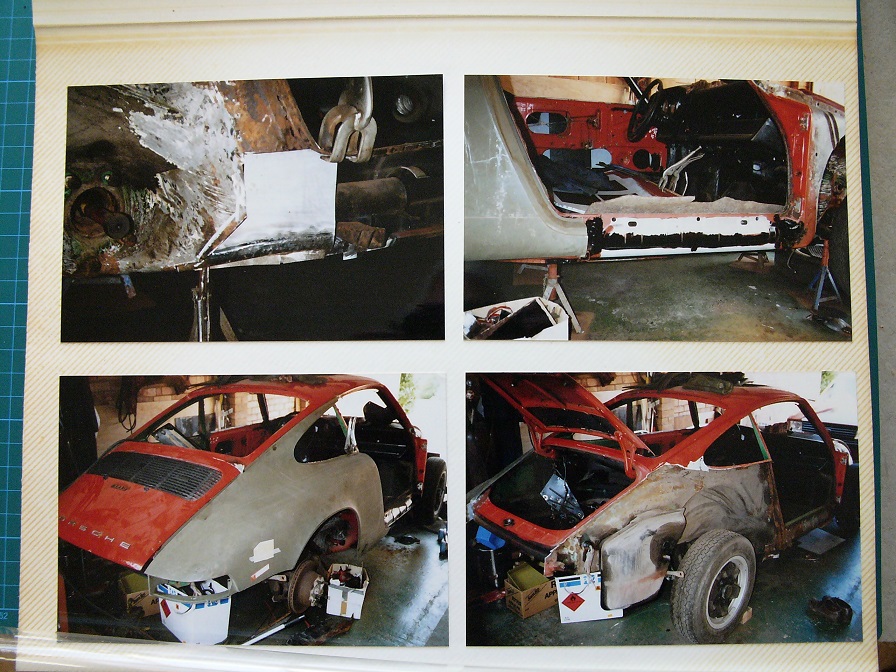

to anyone whos considering taking this on.
Ive seen many variations of where to do the "cut" on this panel.Ive also done a few variations over the years too.
Unless you are a very experienced metal work guy id suggest not to attempt to undue the roof/gutter seam.
There are 3 interjoining seams in there, and its hellish both in terms of actually separating them and refitting.Its likely that you will add some distortion to the outer roof line,which will
in itself cause further issues to get the flow looking right,plus trying to justify the hours involved.Which is probably why even 911 body guys dont do this.
One of the most common "cuts" I seen is above.
Cut middway from rear window apperture and generally finishing around the end of the rain channel flange.
This introduces a few issues that will require far more work in the finishing stages.
Firstly that cut is over 12 inches long.The panel is only about 1mm.There are no folds or edges that offer any resistance to shrinkage.
Most bodyshops use MIG.I can pretty much assure you, that Migging that area will cause the panel to suck in and distort,no matter how patient you are.
Ive been using TIG for 20 plus years,and would still suffer with some degree of shrinkage/warping, even though TIG is far more precise and localised.
So now the panel is warped.Well yes every panel does to some degree.That is usually corrected by dolly/hammer work.
However you cant acess the area with a dolly.Only option now is to either use an electric panel puller to pull it up,or fill it full of filler.
I actually watch a 911 body shop on Youtube do this cut, then had to load another film showing how to correct it.It wasnt pretty.
The rear haunches of a 911 are a mix of flowing swooping lines.I kinda look at bodywork differently,cos I do it.I can generally see when this area has been filled.Its work intensive and tricky
to get the flow back exactly as it was.
The best way (imho) is to cut high and close to the rain channel.Usually 10mm away.
Any heat will run into the rain channel which is far more resistance to warpage.Sure the main panel is a larger area, but heat is kept to a minimum.
Plus of course you get acess right under the inner wing.A lower cut conceals an area which is prone to corrosion that you cant acess.
You can use the rain channel as a guide for a cut line,and get an almost perfect 1mm or so gap to weld into and use panel clamps to keep it tight.
Mikes Car was done this way.Zero distortion.Barely visible weld lines.Just a smidge of lead loading.
Hope this is helpful.