


While the current spec engine is still together, I thought I'd get the oil analysed to see what was (or wasn't) wearing. The results were both interesting and very reassuring. I'd been using Millers 20/50 classic motorsport synthetic oil so opted to have the procedure carried out by Millers – it costs about £40. There are cheaper services around but I trusted Millers to do a good job. Once you pay on line, they mail you a sample bottle, which you fill and return to them using the prepaid packaging. They received my sample on on Tuesday and the results were e-mailed to me today (Friday). Pretty good considering the time of year.
This is the overall result shown in graph form, indicating contamination by ppm.
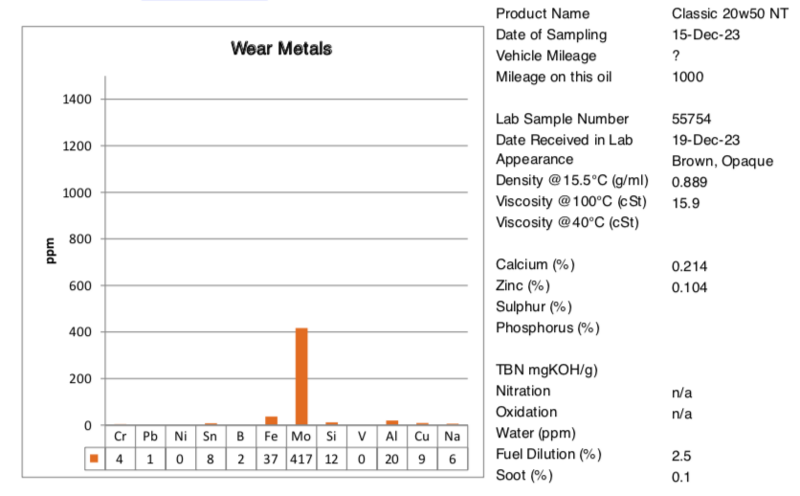
Starting from the left, contamination levels by Cr (Chromium - typically from rings), Pb (Lead - bearings), Ni (Nickel – typically crank journals and camshaft lobes), Sn (Tin – bearing coatings) and B (Boron – oil additive) are all very low, showing negligible wear. Fe (Iron – cylinder walls, rings, cam gear etc) is slightly raised, but still low, while Mo (Molybdenum – plating used on piston rings) is highest. That doesn't surprise me, but I'll come back to that. Si (Silicon – seals and sealant) contamination is low, V (Vanadium – only really relevant in diesels apparently) is non existent, Al (Aluminium - pistons) is slightly raised but still considered low), Cu (Copper - bearings) is low while Na (Sodium – oil additive) is also very low.
Basically, the only components that have worn are piston rings, followed by cylinder walls and pistons, although the latter two are still well below a level to cause any concern. Part of the reason I am carrying out an upgrade is to reduce the amount of piston slap brought about by short rods with a long-stroke crank. This is what has led to the rings suffering and hence traces of iron and molybdenum in the oil.
The oil has also been contaminated by fuel (2.5%) – Millers told me this is common in a competition engine. As a consequence, oil viscosity at 100°C is 15.9 as opposed to the target 20w. However, their exact words were "The viscosity is acceptable with a 'caution' level of fuel dilution (this is normal in competition engines). Wear metals are at a satisfactory level."
So, all good and I can breath again knowing that the oil system is working just fine. I am convinced that the failure of the rod bearing in the original engine was caused by a lack of lubrication on start-up from cold. I also feel this vindicates my decision to install an Accusump, meaning I can pre-lube the engine at 20psi before turning the key.


