

The last time I did any meaningful report on my attempts at hillclimbing was around July 2024, followed by a brief look at various events in 2025, including the tale of woe that was St Gouéno – but enough of that... I was very happy with things at Werrington last year, the decision to shift into fourth going up the lower part of the hill was a game-changer – Wiscombe and Tregrehan are 2nd and 3rd gear hills for me, although I've been red-lining the car in 3rd up Castle Straight at Wiscombe, so that may change, too...
Overall, accident aside, 2025 was a disappointing year for me, with my four trips to Wiscombe seeing me struggling with a) grip and b) that damned stumble exiting Sawbench and Martini corners. When sitting in the car at the top of the hill after a run, I always dig out my iPhone and log onto the live on-line timing to see how I've done. Then I usually add a little comment to remind me later about what I thought at the time. This year's comments summed it all up: 'Crap!', 'Still bogging down', 'Ditto', 'Crap – felt fast...'. That was the first event, the only time this year I got under 50 seconds, which is an absolute joke. Next meeting: 'Wheelspin out of hairpins','Bogged on line', '2nd to 5th AGAIN! Idiot...', 'Great run but why so slow?' This was followed by the first event post-St Gouéno: 'So wet and greasy!', 'Better', 'Wetter!', "No comment...'. The final meeting was shortened to two runs: 'Joke!!!' followed by 'No comment'. Says it all really.
I was not happy and mentally in a bad place. The car felt better out on the road than it's ever done thanks to spending time, post crash, on a Celete jig and followed by a full-on laser alignment session. But a change of tyre to some Nankang AR-1s (chosen because of their excellent reputation among the trackday crowd, and their alleged ability to warm up quicker than the Toyo R888Rs I'd been using) had left me feeling underwhelmed. On the road they were/are great but they still don't get hot enough to deliver better grip on the hills. Being realistic, most of the time I run down here in the southwest, the track temps are low and, especially at Wiscombe under the trees, the track is rarely completely dry. Looking around the paddock at cars of a similar size/weight, it looks like Yokohama A052s might be the answer as they have a 'proper' tread pattern and a softer compound. But they are expensive at 50 per cent more than the Toyos and double the price of the Nankangs! Ouch...
But if I run in the right conditions, I know that car could run as much as a second quicker IF I can cure that stumble (bog) pulling out of the two Wiscombe hairpins. Initially I thought it was fuelling, then everyone said it is more likely electrical, but I couldn't find anything obviously wrong on that score. So once again, I began to look at the fuel system. I was happy with the pumps – a Facet solid-state doing the lift pump duties into a 1.5-litre swirl-pot, from which a Bosch high-pressure FI pump sends fuel onto the engine bay. But I have always been aware of a smell of petrol in the car after it's sat for a while, and this seems to be symptomatic of ageing original (plastic) fuel lines that run through the tunnel. So they're going to be changed, as is the original fuel tank, which I know is not as rust free as I'd like. Fuel lines and fittings from the pump back are being changed to 6AN throughout, for both feed and return. The new fuel lines are FIA-spec steel-braided Teflon (PTFE) hoses which can run inside the car, with bulkhead fittings at each end. All current 6AN hoses in the engine bay are being changed at the same time. The new fuel tank is having a new breather added, located in the centre of the top of the tank – video taken from head on at St Gouéno has shown that fuel is being forced out of the stock breather (located on the fuel filler neck) on left-hand bends. Even though the stock tank is baffled, it shows how much the contents get thrown around... Overkill? Maybe, but the reality is that the fuel lines and tank are over 50 years old so as far as I'm concerned they're long overdue for change.
But (and a big but at that) I still had doubts about the spec of the EFI system itself. The throttle bodies are secondhand 48mm ITBs from CB Performance which originally graced Graham Rawlings' nine-second VW dragster. The injectors are Bosch 'green' and, between the ITBs and the injectors, I think (hope) I've put my finger on the root of the problem. Now I know that an ITB + ECU set-up can be more forgiving than a traditional 'carbs and coil' system, but the basics still remain the same: to perform well at all throttle openings and at all rpm, the engine needs precise fuel delivery and sufficient air speed through the throttle body/choke/venturi. I started to question the size and spec of the ITBs and injectors, so spent a long time on line to get to the bottom of things. First of all the ITBs. There are two ways to 'guesstimate' the ideal size of a throttle body, one very simple, the other somewhat more complex. The simple way is to take the likely power output of the engine and divide it by the number of cylinders. Yes, that crude and simple. In its current trim, the engine puts out roughly 180bhp, so divide that by four and you get 45 (as in millimetres diameter). A more complex formula which takes into account engine capacity, number of cylinders, anticipated power output and engine rpm came up with a figure of 45.5mm. The current 48mmm ITBs would suit an engine of either larger capacity or one which produces maximum power at far above the 6000rpm of mine (largely determined by cam and head spec). If I had a 2.7-litre engine or one that spins to 8000rpm, then no problem, but I don't, so hence treating myself to a new set of 45mm ITBs from the VW Speedshop – and very nice they are, too. No, more than that: they're beautiful, UK made and very fairly priced. Sadly they are only available with four-cylinder engines in mind, so tough luck 911 owners...
 The larger ITBs are, in my mind, a major part of the reason why the car struggles at wide-open throttle at low rpm under load – think of how your 1300cc Beetle would behave if you threw a set of 48IDA Webers on it.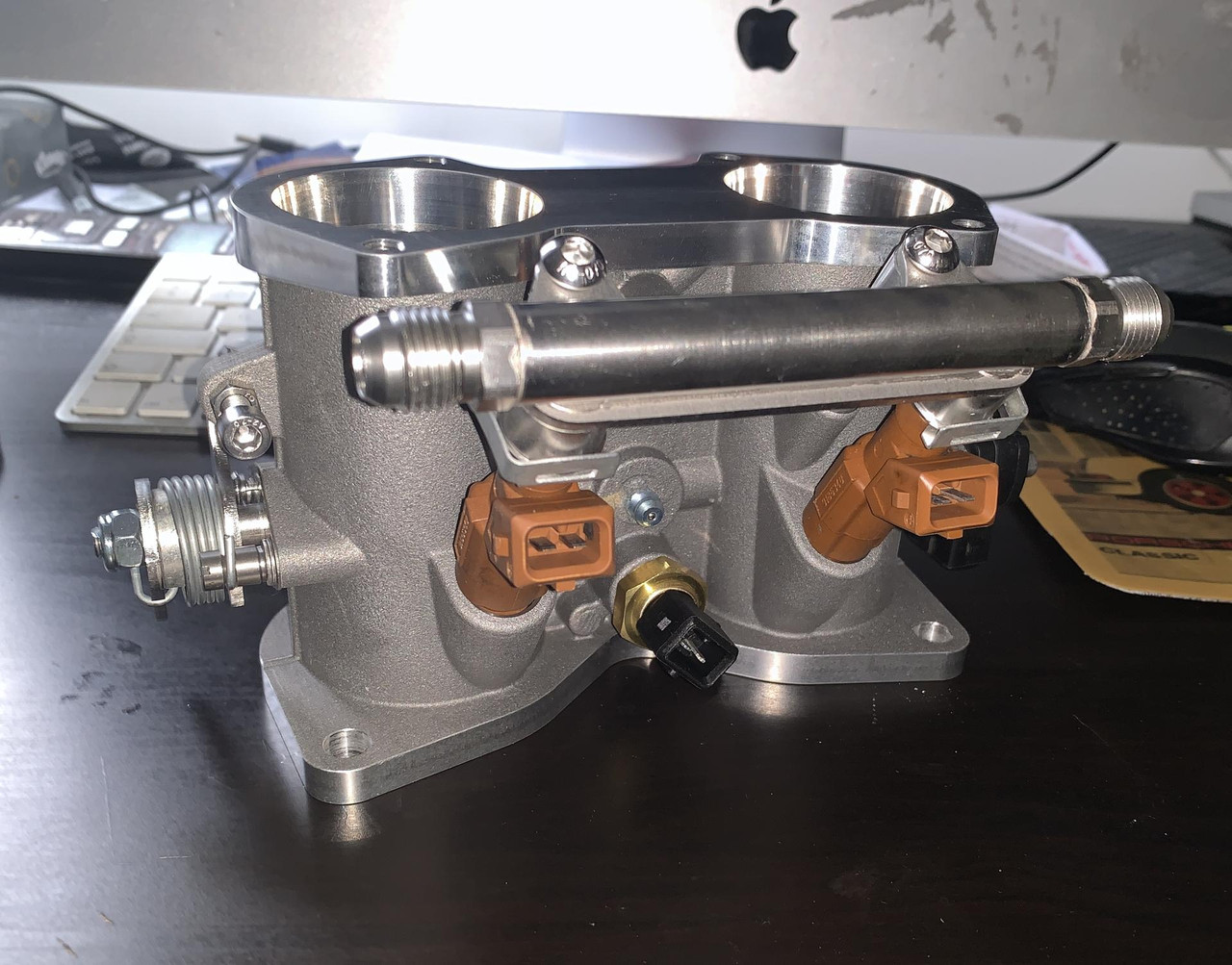
As for the injectors, I've had my suspicions for a while that they might be too big for my needs, so I looked into that, too. The current Bosch 'green' injectors are rated at 440 cc/min and that means they are suited to four-cylinder engines producing up to 320bhp – far more than my needs. On the other hand, the 'brown' injectors (used on several Volvos – V70s and the like) are rated at 330 cc/min (25 per cent less than the 'green') and are suited for four-cylinder engines producing up to 240bhp. While mapping the ECU so that the larger injectors can work OK most of the time is possible, the two areas where they struggle are at idle and low rpm under load. They over fuel as they are difficult to control in those situations. So I now have a set of Bosch 'brown' Volvo injectors sitting on my desk. Oh, and those lovely new ITBs (with longer ram pipes to help with low-end torque...).
Let's get Christmas out of the way and then we'll see what happens...