The 'Maverick' Classic Porsche Forum and Classic Porsche Club for Porsche 356, Aircooled Porsche 911, Porsche 912, Porsche 914 & Porsche Replicas. 'We join for the cars but stay for the people'
According to my Bruce Anderson book, all engines had squirters in 1971, the 2.2 capacity change.
They have a valve in them so they pass oil at about 50 psi oil system pressure to cool the piston crowns. I imagine the position and inclination is critical so the crown gets squirted and not the piston skirt instead.
I think they are peened into place but could be wrong.
A very long time ago Bob Watson discussed this with me when I DIY'd my 2.4 E/S engine build.
I would ask Porsche first if they supply them, but as I think they are not replaceable parts you might struggle?
If one comes out there could be a dramatic oil pressure loss, so this is critical imho!
My memory is not at it's best now, so check everything!
73T 911 Coupe, road/hillclimber 3.2L
Lola t 492 / 3.2 hillclimb racer
Boxster 987 Gen II 2.9
just my 2 P for you, not that it is worth anything
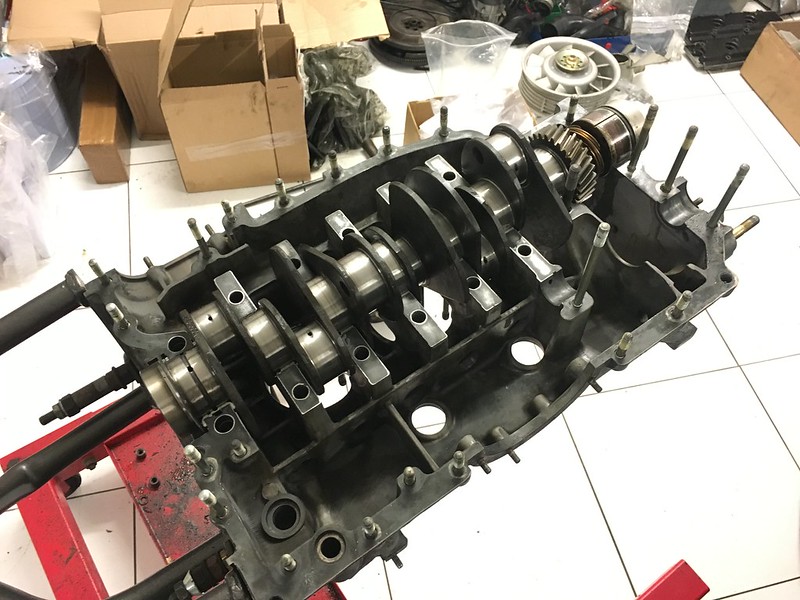
before you remove the piston squirters, check that they need to be re-placed, as I have a engine in the shop at the moment that has had the valves removed and have the 6 to re-fit, the prob' is getting them to stop in and not get them blocked when re-fitting, the pining/locking of the case is not as good as it was when the case was new, as the Mag is now a lot harded to bend, hit it to hard and it will brake off, if hit lightly there is a chance the valve will work it way out, if you remove them they should be a tight fit in the case, but not that tight you can not pull them out with a small thread tap to remove them, the set of cases hear in the shop at the moment that have been treated and the valves are slack and I am in the process of checking all the valves avilable for a better fit, there are O/S Dia' valves to fit in there
as for the pining of the main bearings, 4 out of 5 Mag engine I have through the shop need pinining, due to the age of the Mag and the heat cycles the engine has run through, if you do decide not to pin, then build the cases and crank and then tighten all the main bearing through bolts and check the crank turns by HAND, and even then there is still a chance it will lock up on the build when all the nut/bolts are tightened
if you are doing the oil bypass, you will need at least a 4 rib oil pump, later oil releaf valves, springs and caps
Thanks for the input. The case is pre piston squirters so Rob will be drilling them in for the first time. Getting them to stay in place was one of my worries but I'm guessing freshly drilled holes will help this?
You've got me questioning the shuffle pinning again. As far as I can tell this is the first time the case has been split and it's done 70k miles. Not sure if this makes any difference?
1970 911E Sportomatic
2002 Boxster S
2004 Audi A2 TDi 90
Gosh, that looks scary! I know nothing about machining , but I don't like the idea of machining holes in the rods. How do you know that it won't cause stress cracks?
And how do you know the oil will go in the right place and by the right amount?
I think Jeff in Oz (big video restoration on this page) had this done. The guy machines a slot down the face of the big end of the rod. The oil under pressure flows along this slot so producing a jet of oil and at speed will reach (he expects) the underside of the piston so quenching it just as the squirter does.
However, the squirter has a fixed position so can shoot the jet right at the piston but the slot will be describing an arc as it moves relative to the crank and piston position, thus the oil jet is distributed rather than targeted.
I'm not convinced this mod is as effective as the real squirter in the crank case web drilled straight into the oil gallery and with a valve fitted so the oil will 'jet' only when a high enough pressure it reached, ie well over tick over pressure.
Cheaper and easier mind to do!
73T 911 Coupe, road/hillclimber 3.2L
Lola t 492 / 3.2 hillclimb racer
Boxster 987 Gen II 2.9
Regarding shuffle pining: there was considerable
discussion on here last year and some on early911sreg
when I raised the topic. I think there is now an expectation that shuffle pining is necessary but it does not appear to have a sound engineering foundation. However, if you sell the car at a later date with a rebuilt engine you are likely to be asked if it 'has been shuffle pinned'. The potential buyer is highly unlikely to have a sound engineering background so it can be viewed as a simple prejudice in this context. The notion that a series of small diameter pins with a tolerance around them for fitting the case halves together can some how arrest movement of the case halves during expansion and contraction of the case halves has not been proven as far as I can determine. The signs of case halves moving relative to each other causes "fretting" of the two mating surfaces. I could only find one person who claimed that he had observed fretting on a competition engine( subject to 8500 RPM on a sustained basis). Incidentally this engine it was claimed had both been shuffle pinned and had through bolts. In a road engine would such sustained RPM figures be the norm?
As Richard said the factory did not shuffle pin even very high reving high output engines. He rightly said that case through bolts were used in the RSR. I understand that at least one very well known engine builder currently uses these.
Shuffle pinning must be carried out to very accurate tolerances otherwise it may do more harm than good. With 40 plus year old engine cases this is easier said than done.
Rob Walkers have fitted my Piston squirters now. Still waiting on them finishing the crank and other bits but I decided against Shuffle pinning firstly from reading forums and secondly from Robs advice. I figured if the guy I was going to get to do it was against the idea then perhaps I should not proceed.
1970 911E Sportomatic
2002 Boxster S
2004 Audi A2 TDi 90
I had the same discussion with Rob when he did my case. It was honed with it all torqued together and the crank turned easily by hand after assembly. I dry built it first just to check it went round with everything done up.
The final build is a scary moment as you are up against time to torque everything correctly in the right sequence before the Loctite goes off, and hope the crank still turns!