

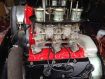
Stock 3.2 flat six in my hill climb Lola t 492, engine very healthy and mainly used on wot most of the time.
On a hill climb you have about 50 seconds of flat out race run and about 6 gear changes.
Flexibility of the engine is paramount, fuel consumption is irrelevant, cold and hot start very very important.
Car runs on Shell V Power.
It has equal length tube exhaust, each back is silenced separately, and runs PMO carbs, KN filters.
If you are not familiar with the car Google Lola 492 hill climb and mine is all over the image page.
Ignition is an RS 2.7 distributor with a 73t rotor arm, simple coil and condenser, real old school stuff.
Car runs well. Question is about the size of the carbs to the engine.
They are the big 50mm choke carbs which can fuel up to 3.8 litres, maybe beyond.
Iirc the choke size are 36mm.
Many years ago it was setup by Bob Watson who had 247 bhp from it at the flywheel. He thought the carbs too big, and 45mm would be better, and the calcs in the Bruce Anderson book would agree with him. 46mm would be perfect for the 3.2.
Are these well running carbs holding power and torque back?
Would 45/46mm carbs give much gain?
247 bhp seems a bit light for this spec, but would be interested to see what you all think.
PMO manifolds are used and match to the engine heads and carbs.
I really do not want to go through the change to ITB as I doubt I will find a useful power or torque gain verses the cost and mapping etc.
A question of carb sizes verses torque, verses power.
Moderators: hot66, impmad2000, Nige
-
911hillclimber
- Nurse, I think I need some assistance
- Posts: 20702
- Joined: Mon Mar 10, 2008 6:26 pm
- Location: West Midlands
A question of carb sizes verses torque, verses power.
73T 911 Coupe, road/hillclimber 3.2L
Lola t 492 / 3.2 hillclimb racer
Boxster 987 Gen II 2.9
Lola t 492 / 3.2 hillclimb racer
Boxster 987 Gen II 2.9
-
Ashley James
- Put a fork in me, I'm done!
- Posts: 1654
- Joined: Tue Jul 12, 2016 3:30 pm
- Location: Near Stroud, Glos. UK
- Contact:
Re: A question of carb sizes verses torque, verses power.
Speaking as someone with no experience of your engine, but some of racing Motorbikes and strangely of the impact of extra carburettors on American V8s, I doubt that small a change would make a difference you'd notice. Basically the bigger the carb diameter, the more top you get at the expense of mid and low.
Do the carbs have interchangeable venturis and have you got a rolling road locally that would enable you to experiment?
Do the carbs have interchangeable venturis and have you got a rolling road locally that would enable you to experiment?
-
911hillclimber
- Nurse, I think I need some assistance
- Posts: 20702
- Joined: Mon Mar 10, 2008 6:26 pm
- Location: West Midlands
Re: A question of carb sizes verses torque, verses power.
Thanks for the speedy reply!
The PMO carbs are great instruments, and are cast as a 50mm and then sleeved for 46 and 40mm with corresponding butterflies etc.
I imagine I could down size my 50mm to 46 but cost would be silly for any gain I imagine to make.
I think because the engine is run as good as 'pedal to the metal' all the time the size difference is not too much of an issue, but I'm trying to see if I'm dreaming or not.
I'm on hols now, but might email Richers Parr at PMO for his thoughts.
Richard has helped in the past, but UK hill climbing is not readily understood in California, auto crossing is about as close as I can get to explain what I do.
Bruce Anderson makes a bit of an issue about engine size and carb size, but he is always considering compromises needed for road use, and always webers, not PMO.
I am always crating around to find a bit more from this combination!
The PMO carbs are great instruments, and are cast as a 50mm and then sleeved for 46 and 40mm with corresponding butterflies etc.
I imagine I could down size my 50mm to 46 but cost would be silly for any gain I imagine to make.
I think because the engine is run as good as 'pedal to the metal' all the time the size difference is not too much of an issue, but I'm trying to see if I'm dreaming or not.
I'm on hols now, but might email Richers Parr at PMO for his thoughts.
Richard has helped in the past, but UK hill climbing is not readily understood in California, auto crossing is about as close as I can get to explain what I do.
Bruce Anderson makes a bit of an issue about engine size and carb size, but he is always considering compromises needed for road use, and always webers, not PMO.
I am always crating around to find a bit more from this combination!
73T 911 Coupe, road/hillclimber 3.2L
Lola t 492 / 3.2 hillclimb racer
Boxster 987 Gen II 2.9
Lola t 492 / 3.2 hillclimb racer
Boxster 987 Gen II 2.9
-
Ashley James
- Put a fork in me, I'm done!
- Posts: 1654
- Joined: Tue Jul 12, 2016 3:30 pm
- Location: Near Stroud, Glos. UK
- Contact:
Re: A question of carb sizes verses torque, verses power.
As I say, I'm no expert, but another factor is inlet tract length. Brit sports car manufacturers never got theirs long enough, so with even slightly warm cams, they lost tickover and torque below 3000, whereas 356/912s have nice long ones and quite fierce cams and yet still pull pretty well from tickover.
When Porsche went from 964 to 993 they fitted variable length inlet tracts to improve torque and I believe Honda has them on some of their V-Tec engines.
Another question you could ask.
Have you ever watched Roadkill and their spin offs, because they cover all this by building V8s with different head, cam, carburettor combinations and showing the results on a dyno. They're on YouTube with good definition and well worth watching. It teaches enormous respect for American V8s if not the amount of fuel they consume.
Ash
When Porsche went from 964 to 993 they fitted variable length inlet tracts to improve torque and I believe Honda has them on some of their V-Tec engines.
Another question you could ask.
Have you ever watched Roadkill and their spin offs, because they cover all this by building V8s with different head, cam, carburettor combinations and showing the results on a dyno. They're on YouTube with good definition and well worth watching. It teaches enormous respect for American V8s if not the amount of fuel they consume.
Ash
-
Mike911scrs
- I luv DDK!
- Posts: 819
- Joined: Fri Mar 31, 2006 10:54 am
- Location: Kendal CUMBRIA
Re: A question of carb sizes verses torque, verses power.
HI Graham
what cams have you in the engine, the carb's are good for upto around 285-300BHP along with the manifolds (are the manifolds Long or Short) and head inlet ports, the exhaust port on the head will also flow OK, the only 2 things left are the cams and the exhaust, along with the C.R. on the engine.
regards mike
what cams have you in the engine, the carb's are good for upto around 285-300BHP along with the manifolds (are the manifolds Long or Short) and head inlet ports, the exhaust port on the head will also flow OK, the only 2 things left are the cams and the exhaust, along with the C.R. on the engine.
regards mike
-
MikeB
- Put a fork in me, I'm done!
- Posts: 1927
- Joined: Thu Aug 07, 2008 11:13 pm
- Location: N. Ireland
Re: A question of carb sizes verses torque, verses power.
Graham
As you will know in hillclimb in a you need torque, and with the courses you run on, you are accelerating, braking hard into tight corners and then accelerating again, it's not all flat out and high revs.
A std 3.2 makes about 230 up, so your carbs and exhaust have added a further 17hp ( pretty much what a chip change would have done the std engine). To make more power you'll need the engine to be able to rev higher, and your existing carbs and exhaust can probably be altered to suit, e.g. Chokes and jets. But to do that you'll need pistons and rods, cams, valve spings and other exotic internals. So if the engine currently isn't stuttering when pulling out of Prescott's hairpin, fiddling with the carbs while keeping the engine in standard trim, isn't going to produce much dividend.
As you will know in hillclimb in a you need torque, and with the courses you run on, you are accelerating, braking hard into tight corners and then accelerating again, it's not all flat out and high revs.
A std 3.2 makes about 230 up, so your carbs and exhaust have added a further 17hp ( pretty much what a chip change would have done the std engine). To make more power you'll need the engine to be able to rev higher, and your existing carbs and exhaust can probably be altered to suit, e.g. Chokes and jets. But to do that you'll need pistons and rods, cams, valve spings and other exotic internals. So if the engine currently isn't stuttering when pulling out of Prescott's hairpin, fiddling with the carbs while keeping the engine in standard trim, isn't going to produce much dividend.
Cheers
Mike
RS Rep 3.0 on Webers
Mike
RS Rep 3.0 on Webers
-
911hillclimber
- Nurse, I think I need some assistance
- Posts: 20702
- Joined: Mon Mar 10, 2008 6:26 pm
- Location: West Midlands
Re: A question of carb sizes verses torque, verses power.
Probably right Mike!
I guess this drive train has come to the end of its useful hill climb life, and any changes would be best done using a more modern configuration such as a 3.4 Boxster
The base engine of thic car would be worth keeping for my 911's 3.2 replacement when it is due, the box is worth a few shillings too in a road car.
I guess this drive train has come to the end of its useful hill climb life, and any changes would be best done using a more modern configuration such as a 3.4 Boxster
The base engine of thic car would be worth keeping for my 911's 3.2 replacement when it is due, the box is worth a few shillings too in a road car.
73T 911 Coupe, road/hillclimber 3.2L
Lola t 492 / 3.2 hillclimb racer
Boxster 987 Gen II 2.9
Lola t 492 / 3.2 hillclimb racer
Boxster 987 Gen II 2.9
-
fetuhoe
- DDK rules my life!
- Posts: 1044
- Joined: Tue Aug 23, 2005 1:06 pm
- Location: Midlands
Re: A question of carb sizes verses torque, verses power.
Graham,
The questions you are posing are interesting and result from the typical discussions that suggest torque and horsepower are competing characteristics of an engine.
Horsepower is, IMHO, an imaginary number. It is convenient way of comparing engines and is simply the product of torque and rotational speed and cannot be directly measured but only calculated.
It is, however, a useful because it really defines the rate at which work (in the formal sense) can be done.
Torque, which can be measured, is a useful number but has much less meaning in terms of vehicle performance.
For example if we try to undo a wheel nut with a 1 metre long bar and apply a force of 75Newtons but the nut doesn’t turn we have a torque of 75Nm but we have done no work and horsepower simply calculates to zero.
The torque curve of an engine, taken in isolation, tells us little or nothing about the performance of the vehicle and will never let us calculate anything about acceleration without much more data.
The difference in engine speed between peak torque and peak horsepower is a guide to ‘drivability’ as generally the greater the spread the more the drivability.
In terms of basic Physics the greater the horsepower the faster the acceleration but this over-simplistic statement relies on the choice of suitable gearing.
What we really need to consider is the tractive effort curve for each gear ratio and looking at performance from this perspective is an interesting exercise.
With regard to carburettor sizing and its impact on engine performance I also believe that there is a significant level of misunderstanding.
It is the ability of the engine to burn fuel that is the important and the carbs only role is to meter and supply the engine with the correct amount of fuel and air at the varying throttle openings needed to successfully drive the car.
The ability of the engine to use fuel correctly is in general terms a function of cam timing, valve sizes and a significant number of other variables.
These characteristics define the torque curve of the engine versus engine speed and the final result is the calculated horsepower curve.
Once an engine is at wide open throttle providing that the carb doesn't restrict air flow and meters fuel to provide the 'right' AFR it will have no impact on Horsepower or the Volumetric Efficiency of the engine.
There are a few ways of selecting the basic size of carb required on a specific engine and in the early days of fixed venture carbs relied on the basic calculation of the required CFM and hence the barrel size of the carb.
This methodology tended to mean that carbs were overspecifed in terms of barrel size and this had a negative impact on ‘progression’ behaviour.
More recently various formulae have been developed which allows the optimum ‘venturi’ size to be determined.
Once the venturi size has been determined barrel size is normally chosen on the basis of a simple relationship: Barrel Size = Venturi Size * 1.25
This factor optimises the depression developed at the main jet and allows it to provide fuel evenly over a relatively wide power band.
On Race engines with relatively large carbs this factor often falls to 1.1 but at low engine speeds this can result in uneven fuel delivery from the main jet which will reduce drivability.
The other impact of carbs that are too large will be on the acceleration of the fuel/air charge into the engine.
The larger the barrel of the carb the greater the inertia of the air column and the slower its acceration potentially resulting in a poor throttle response.
Optimising these basic characteristics in terms of the intended application is relatively important and looking at all of the aspects of the car is part of this analysis. From a cost point of view optimising gearing may give more improvement than engine mods of a cash/ET basis.
I would think that in general terms the carbs are bigger than needed for the horsepower being developed so the throttle response may be suffering.
I would also think that the car is significantly overgeared and to some extent the broad torque band may help overcome this problem.
The latest 4 cylinder Turbo Cayman engines look good but if you are going to add water then Subaru Impreza Turbos could also provide a huge power increase with a suitable sequential transmission.
There are some interesting Subaru Transmissions converted for 2-WD with sequential shifts.
The questions you are posing are interesting and result from the typical discussions that suggest torque and horsepower are competing characteristics of an engine.
Horsepower is, IMHO, an imaginary number. It is convenient way of comparing engines and is simply the product of torque and rotational speed and cannot be directly measured but only calculated.
It is, however, a useful because it really defines the rate at which work (in the formal sense) can be done.
Torque, which can be measured, is a useful number but has much less meaning in terms of vehicle performance.
For example if we try to undo a wheel nut with a 1 metre long bar and apply a force of 75Newtons but the nut doesn’t turn we have a torque of 75Nm but we have done no work and horsepower simply calculates to zero.
The torque curve of an engine, taken in isolation, tells us little or nothing about the performance of the vehicle and will never let us calculate anything about acceleration without much more data.
The difference in engine speed between peak torque and peak horsepower is a guide to ‘drivability’ as generally the greater the spread the more the drivability.
In terms of basic Physics the greater the horsepower the faster the acceleration but this over-simplistic statement relies on the choice of suitable gearing.
What we really need to consider is the tractive effort curve for each gear ratio and looking at performance from this perspective is an interesting exercise.
With regard to carburettor sizing and its impact on engine performance I also believe that there is a significant level of misunderstanding.
It is the ability of the engine to burn fuel that is the important and the carbs only role is to meter and supply the engine with the correct amount of fuel and air at the varying throttle openings needed to successfully drive the car.
The ability of the engine to use fuel correctly is in general terms a function of cam timing, valve sizes and a significant number of other variables.
These characteristics define the torque curve of the engine versus engine speed and the final result is the calculated horsepower curve.
Once an engine is at wide open throttle providing that the carb doesn't restrict air flow and meters fuel to provide the 'right' AFR it will have no impact on Horsepower or the Volumetric Efficiency of the engine.
There are a few ways of selecting the basic size of carb required on a specific engine and in the early days of fixed venture carbs relied on the basic calculation of the required CFM and hence the barrel size of the carb.
This methodology tended to mean that carbs were overspecifed in terms of barrel size and this had a negative impact on ‘progression’ behaviour.
More recently various formulae have been developed which allows the optimum ‘venturi’ size to be determined.
Once the venturi size has been determined barrel size is normally chosen on the basis of a simple relationship: Barrel Size = Venturi Size * 1.25
This factor optimises the depression developed at the main jet and allows it to provide fuel evenly over a relatively wide power band.
On Race engines with relatively large carbs this factor often falls to 1.1 but at low engine speeds this can result in uneven fuel delivery from the main jet which will reduce drivability.
The other impact of carbs that are too large will be on the acceleration of the fuel/air charge into the engine.
The larger the barrel of the carb the greater the inertia of the air column and the slower its acceration potentially resulting in a poor throttle response.
Optimising these basic characteristics in terms of the intended application is relatively important and looking at all of the aspects of the car is part of this analysis. From a cost point of view optimising gearing may give more improvement than engine mods of a cash/ET basis.
I would think that in general terms the carbs are bigger than needed for the horsepower being developed so the throttle response may be suffering.
I would also think that the car is significantly overgeared and to some extent the broad torque band may help overcome this problem.
The latest 4 cylinder Turbo Cayman engines look good but if you are going to add water then Subaru Impreza Turbos could also provide a huge power increase with a suitable sequential transmission.
There are some interesting Subaru Transmissions converted for 2-WD with sequential shifts.
-
Ashley James
- Put a fork in me, I'm done!
- Posts: 1654
- Joined: Tue Jul 12, 2016 3:30 pm
- Location: Near Stroud, Glos. UK
- Contact:
Re: A question of carb sizes verses torque, verses power.
I think torque is more important than bhp and as important if you're racing or hill climbing. Both are measurements of available power, but your engine only develops full power at peak revs and most barely use half of that and benefit enormously from the extra torque provided by turbocharged engines a little bit above tick over.
-
smallspeed
- I used to have a life, then came DDK
- Posts: 3856
- Joined: Mon Mar 31, 2008 12:38 pm
- Location: leicester
- Contact:
Re: A question of carb sizes verses torque, verses power.
Definitely have a read of this - as Ashley mentioned mostly the trumpets are too short and fat in older engines..
http://www.emeraldm3d.com/articles/emr- ... th-intake/
I also wouldn't be afraid of itbs and an ecu, as a lot of the tuning can be done without huge cost. An inbetween option might be something like megajolt - programmable spark without the additional complication of fueling and making itbs fit/work.. A lot of the power gains on more modern cars come from ignition timing and mapping now rather than fueling, so im sure you could make gains here with better control and more consistent spark once the carbs are sized and set up.. HTH
Ben
Ps happy to help with any of this stuff if you need it -I've built a fair few ecus and ignition modules over the years, plus a couple of itb conversions on older 911's / aircooled vw's
http://www.emeraldm3d.com/articles/emr- ... th-intake/
I also wouldn't be afraid of itbs and an ecu, as a lot of the tuning can be done without huge cost. An inbetween option might be something like megajolt - programmable spark without the additional complication of fueling and making itbs fit/work.. A lot of the power gains on more modern cars come from ignition timing and mapping now rather than fueling, so im sure you could make gains here with better control and more consistent spark once the carbs are sized and set up.. HTH
Ben
Ps happy to help with any of this stuff if you need it -I've built a fair few ecus and ignition modules over the years, plus a couple of itb conversions on older 911's / aircooled vw's
-
911hillclimber
- Nurse, I think I need some assistance
- Posts: 20702
- Joined: Mon Mar 10, 2008 6:26 pm
- Location: West Midlands
Re: A question of carb sizes verses torque, verses power.
As ever, thank you all!
I have a new competitor coming to my Class, I know him well and obviously I want to keep ahead!
Chris, great respect for you clarity of thought and reasoning as you always have done.
The car today is really tractable, will pull very hard from about 2000 rpm to the red line in a most linear way, and is insensitive to progressive throttle opening or red-mist pedal to the metal approach!
My ex hill climb road going 73t with a stock as a stone (bar the SSi exhaust) drives the same way with Bosch injection an the first chip Bob Watson ever fitted.
Before this Lola I hill climbed a road going Impreza, it was 2 litre and tweeked externally to 350/370 bhp depending which rolling roads used....
Stock type R box and lots of suspension tuning, 3 way dampers etc.
That car was ballistic and won me many pots.
The Impreza drive train was considered for the Lola.
I have a spare gearbox, easy to convert to 2 wheel drive, but it will not fit into the Lola due to the starter motor position and the drive shaft output axis being far too high to align with the suspension.
I have tried this box into the chassis already.
That engine is very small, obviously very short too.
Such a change would remove a lot of weight from the back, a very slick gear change indeed and will run to 7800 as stock.
It needs water cooling but also a very big inter cooler, approx 1000 X 200 X 70 mm with a high air stream flow for 350 bhp.
The cooling of the 350 bhp and air intake in the spaces I have would be tricky.
The gearbox fitting is a major issue.
The gap for the Hewland box in the Lola chassis (that is also where the rear suspension mounts) will just allow the 915 box in using an epicyclic high speed starter motor.
The Hewland box was built into a VW box case, no wonder it fits!
The Impreza clutch is 225 mm dia, close to the 911's and hydraulic.
Kennedy in the USA would be able to fit an Impreza box to the 911 possibly, but that starter is a killer.
All this boils down to a few basic issues
1
If the box was as slick as the Impreza box all could be well. The box I have is one of Mike Bainbridge's finest, but does not take fast shifting well, esp if 2nd gear is involved in the action.
Remember hill climbing is a very sharp sport, drop a few 1/100s of a second and you have lost!
2
The engine I have just is not athletic enough. 6k and the engine is all but done for, time for a fresh gear.
But quickly..see 1 above...
3
Performance.
The car is about 620 kg wet with me in it. I am experienced in this game, now my 26th year, 14 in the 911, 5 in the Impreza, rest in this Lola.
The car will accelerate at 1g from a dry standing start to the 64 foot marker.
It will wheel spin with ease despite an led and 10" wide hill climb slicks, no different when the tyres were 15" wide.
Can't help but think a new drive chain is needed, but space is tight where the bell housing is and cooling rads are hard to supply with air.
The Lola was designed to use a stock 2 litre Pinto engine.
A front mounted rad did not work, and after 10 cars (the Lola T490) the T492 got side mounted water rads, no front one. That worked cooling 120 bhp in a fast circuit situation.
I might be boring you all now so will stop typing!
I have a new competitor coming to my Class, I know him well and obviously I want to keep ahead!
Chris, great respect for you clarity of thought and reasoning as you always have done.
The car today is really tractable, will pull very hard from about 2000 rpm to the red line in a most linear way, and is insensitive to progressive throttle opening or red-mist pedal to the metal approach!
My ex hill climb road going 73t with a stock as a stone (bar the SSi exhaust) drives the same way with Bosch injection an the first chip Bob Watson ever fitted.
Before this Lola I hill climbed a road going Impreza, it was 2 litre and tweeked externally to 350/370 bhp depending which rolling roads used....
Stock type R box and lots of suspension tuning, 3 way dampers etc.
That car was ballistic and won me many pots.
The Impreza drive train was considered for the Lola.
I have a spare gearbox, easy to convert to 2 wheel drive, but it will not fit into the Lola due to the starter motor position and the drive shaft output axis being far too high to align with the suspension.
I have tried this box into the chassis already.
That engine is very small, obviously very short too.
Such a change would remove a lot of weight from the back, a very slick gear change indeed and will run to 7800 as stock.
It needs water cooling but also a very big inter cooler, approx 1000 X 200 X 70 mm with a high air stream flow for 350 bhp.
The cooling of the 350 bhp and air intake in the spaces I have would be tricky.
The gearbox fitting is a major issue.
The gap for the Hewland box in the Lola chassis (that is also where the rear suspension mounts) will just allow the 915 box in using an epicyclic high speed starter motor.
The Hewland box was built into a VW box case, no wonder it fits!
The Impreza clutch is 225 mm dia, close to the 911's and hydraulic.
Kennedy in the USA would be able to fit an Impreza box to the 911 possibly, but that starter is a killer.
All this boils down to a few basic issues
1
If the box was as slick as the Impreza box all could be well. The box I have is one of Mike Bainbridge's finest, but does not take fast shifting well, esp if 2nd gear is involved in the action.
Remember hill climbing is a very sharp sport, drop a few 1/100s of a second and you have lost!
2
The engine I have just is not athletic enough. 6k and the engine is all but done for, time for a fresh gear.
But quickly..see 1 above...
3
Performance.
The car is about 620 kg wet with me in it. I am experienced in this game, now my 26th year, 14 in the 911, 5 in the Impreza, rest in this Lola.
The car will accelerate at 1g from a dry standing start to the 64 foot marker.
It will wheel spin with ease despite an led and 10" wide hill climb slicks, no different when the tyres were 15" wide.
Can't help but think a new drive chain is needed, but space is tight where the bell housing is and cooling rads are hard to supply with air.
The Lola was designed to use a stock 2 litre Pinto engine.
A front mounted rad did not work, and after 10 cars (the Lola T490) the T492 got side mounted water rads, no front one. That worked cooling 120 bhp in a fast circuit situation.
I might be boring you all now so will stop typing!
73T 911 Coupe, road/hillclimber 3.2L
Lola t 492 / 3.2 hillclimb racer
Boxster 987 Gen II 2.9
Lola t 492 / 3.2 hillclimb racer
Boxster 987 Gen II 2.9
-
Gary71
- Nurse, I think I need some assistance
- Posts: 10732
- Joined: Wed Mar 31, 2004 1:27 pm
- Location: Cheshire
- Contact:
Re: A question of carb sizes verses torque, verses power.
Can you low pressure turbocharge it and retain the PMOs? Might be the 'easiest' way to give a substantial power hike.
Optimising carb venturis etc is fiddling with the details in the scheme of what you need.
Sent from my iPhone using Tapatalk
Optimising carb venturis etc is fiddling with the details in the scheme of what you need.
Sent from my iPhone using Tapatalk
-
911hillclimber
- Nurse, I think I need some assistance
- Posts: 20702
- Joined: Mon Mar 10, 2008 6:26 pm
- Location: West Midlands
Re: A question of carb sizes verses torque, verses power.
You sound a bit like Bob Watson, but he wanted to fit twin turbos!
This car needs to be simple to suit me and costs. Not sure pressurising the carbs will be easy.
I think my wife simply wants me to leave it alone now it reliably works!
As Gary knows, it has been a long hard journey to get where I am now.
There is no low cost solution and the car is a neat package and has met my needs when I started on this road.
I bought the car 8 years ago! Only the last two have delivered.
I might win my class this year and have gone steadily quicker over time.
My new competitor is 7 seconds slower than me at Prescott, but he will have 400+ bhp to go with his sequential box soon. He has about 280 now.
I wish I could just sit back and enjoy, but I am still a bit competative...
I have to resign myself that in order to move on it might be easier to sell the car or most likely break it up.
Could go into the road class with my Boxster and get into sub 30 mpg!
Using the Boxster is a serious option and would justify it's cost and current maintenance bills.
It would be ready to race with nicer tyres.
On a more imaginative note, Paul Howells has a new sequential gear set in his RSR and has just gone faster today than my personal best.
Now, there's a thought.
This car needs to be simple to suit me and costs. Not sure pressurising the carbs will be easy.
I think my wife simply wants me to leave it alone now it reliably works!
As Gary knows, it has been a long hard journey to get where I am now.
There is no low cost solution and the car is a neat package and has met my needs when I started on this road.
I bought the car 8 years ago! Only the last two have delivered.
I might win my class this year and have gone steadily quicker over time.
My new competitor is 7 seconds slower than me at Prescott, but he will have 400+ bhp to go with his sequential box soon. He has about 280 now.
I wish I could just sit back and enjoy, but I am still a bit competative...
I have to resign myself that in order to move on it might be easier to sell the car or most likely break it up.
Could go into the road class with my Boxster and get into sub 30 mpg!
Using the Boxster is a serious option and would justify it's cost and current maintenance bills.
It would be ready to race with nicer tyres.
On a more imaginative note, Paul Howells has a new sequential gear set in his RSR and has just gone faster today than my personal best.
Now, there's a thought.
73T 911 Coupe, road/hillclimber 3.2L
Lola t 492 / 3.2 hillclimb racer
Boxster 987 Gen II 2.9
Lola t 492 / 3.2 hillclimb racer
Boxster 987 Gen II 2.9
-
fetuhoe
- DDK rules my life!
- Posts: 1044
- Joined: Tue Aug 23, 2005 1:06 pm
- Location: Midlands
Re: A question of carb sizes verses torque, verses power.
How about one of these

Narrow, top mounting starter - 4 speed sequential Dog Change Handles around 320Nm of torque.
If you re-built the motor as a short stroke 66mm you could get around 330 bhp at 8500rpm

Narrow, top mounting starter - 4 speed sequential Dog Change Handles around 320Nm of torque.
If you re-built the motor as a short stroke 66mm you could get around 330 bhp at 8500rpm
-
911hillclimber
- Nurse, I think I need some assistance
- Posts: 20702
- Joined: Mon Mar 10, 2008 6:26 pm
- Location: West Midlands
Re: A question of carb sizes verses torque, verses power.
I take it back that you are a clear thinker!!
Don't have the 20k or more!
Could sell the old 911 hot rod for enough to do it, but the wife will not sell the 911.
Sell everything and go back 27 years and race the 911?
Spend the money over on more holidays. , but in my Skoda.
Give up cars and do model aeroplanes...
There is no real solution for me and this car.
Don't have the 20k or more!
Could sell the old 911 hot rod for enough to do it, but the wife will not sell the 911.
Sell everything and go back 27 years and race the 911?
Spend the money over on more holidays.
, but in my Skoda.Give up cars and do model aeroplanes...
There is no real solution for me and this car.
73T 911 Coupe, road/hillclimber 3.2L
Lola t 492 / 3.2 hillclimb racer
Boxster 987 Gen II 2.9
Lola t 492 / 3.2 hillclimb racer
Boxster 987 Gen II 2.9