Page 1 of 2

Plug (tip) length difference: Problem?

Posted: Tue Jan 25, 2022 5:22 pm
by 911hillclimber
Just got 12 Iridium NGK plugs for my engine. (#6418)
Have to use these new plugs due to change in ignition system.
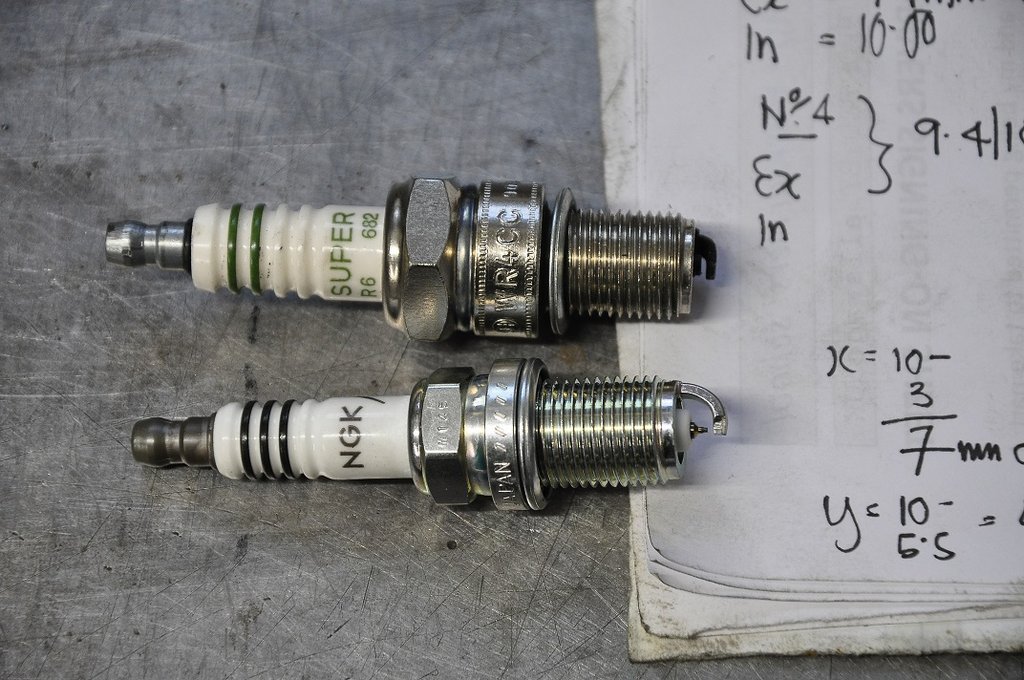
The plug thread is the same length as a 'normal' 911 plug but the tip length is about 3mm longer so will protrude far deeper into the combustion chamber.

I did not expect this and have ordered some spacer washers to go onto the plug against the fitted crush washer so spacing the plug back into the head somewhat.

Question to those who might have hands-on experience, have you used these NGK plugs in a 911 engine and had impact issues with high performance pistons?

Re: Plug (tip) length difference: Problem?

Posted: Tue Jan 25, 2022 5:38 pm
by KS
Not had the experience you're seeking, but just check that the length of the thread on the plug matches the depth of that in the head - if the plug is short (whether by design or as a result of using a spacer) and leaves the thread in the head exposed, you can get a hot spot, which can cause detonation.

Anyway, that aside, back to somebody else to answer your question...

You might be interested in this, though. It's an interesting read:

https://www.enginelabs.com/engine-tech/ ... m-opinion/

Re: Plug (tip) length difference: Problem?

Posted: Tue Jan 25, 2022 5:53 pm
by 911hillclimber
Thank you Keith, just briskly read that and some good info.
Will read it all early tomorrow.
Clewett suggested these plugs, but more based I suspect on spark performance than anything else, my worry is if the pair of longer tipped plugs/cylinder will be too close to the top of the pistons... :roll:

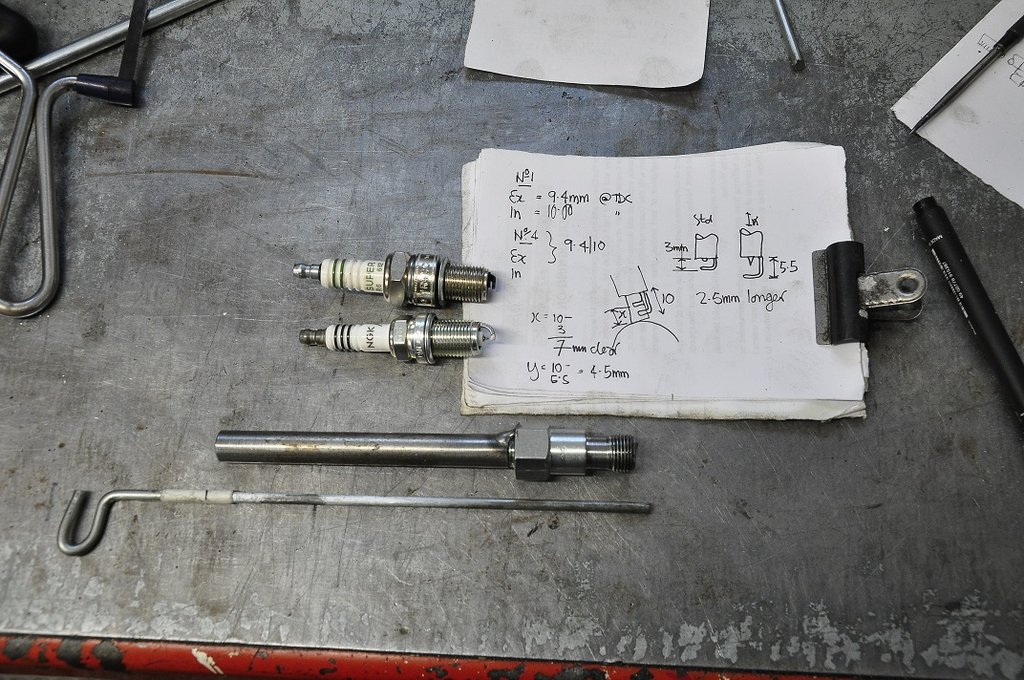
I guess I could make a hollow plug with a sliding 'core' and go into the cylinder deeper and deeper until I can 'just' feel contact @ TDC and compare the dimensions of the 'plug depth gauge' and the new plugs.
That would be a certain measurement at least.
Little job for tomorrow.

Plug (tip) length difference: Problem?

Posted: Tue Jan 25, 2022 8:19 pm
by Bruce M
What is the NGK part number?

Edit: found it, wasn’t that enlightening though.

Re: Plug (tip) length difference: Problem?

Posted: Tue Jan 25, 2022 9:06 pm
by 911hillclimber
Exactly, little info to work on.
Do I HAVE to use these fancy plugs with the Clewett?

Re: Plug (tip) length difference: Problem?

Posted: Tue Jan 25, 2022 9:34 pm
by hot66
No

Re: Plug (tip) length difference: Problem?

Posted: Tue Jan 25, 2022 9:46 pm
by hot66
Think I use wr4cc or bp4es …will have to check

Re: Plug (tip) length difference: Problem?

Posted: Tue Jan 25, 2022 10:22 pm
by 911hillclimber
Thanks James. Please let me know.
I have these expensive plugs now, but if they are too long and hit (or do nearly) the pistons they are scrap.
I have been told by a few these iridium plugs have to be used in this high voltage inductive ignition system, so, being obedient, here I am.

There is a difference of 2mm from the bottom of the thread to the extremity of the plug on the new plugs. I think there is room for this in both plug locations in the head, but i'll make a simple plunger to measure things over the next few days so at least I know the spac available.

Re: Plug (tip) length difference: Problem?

Posted: Wed Jan 26, 2022 4:40 pm
by 911hillclimber
Puzzle now sorted.
Made a 'depth gauge' to see the distance from the TDC/Piston crown to the base of the threaded section of the plug.

There is 9.4mm from the threaded section to the piston crown at TDC, both cylinders #1 and #4.

The ordinary 911 plug electrodes protrude 3mm into the chamber, so have a clearance of 6.4mm (Inlet and exhaust are the same)
The Iridium plugs protrude a further 2.5mm so the clearance is reduced to 4mm so lots of room I think just to use the Iridium plugs as they are, but spacers are awaited.

Image

Image

Re: Plug (tip) length difference: Problem?

Posted: Wed Jan 26, 2022 8:09 pm
by Jonny Hart
911hillclimber wrote: I have been told by a few these iridium plugs have to be used in this high voltage inductive ignition system
Hmm, told by who? That’s not how sparks ‘work’. The potential (voltage) will rise to whatever it takes for the spark to ‘jump’ the gap - typically 30-35kV. If you have a small plug gap, it takes less voltage to ‘jump’. If the gap is large, the voltage will be higher but if too large, the voltage required may be beyond the capability of the ignition and no spark will occur. Btw, this case is also very stressful for the coil and potentially the ignition unit.

Cylinder pressure also increases the voltage required as the gap effectively becomes an even higher resistance to the spark. That’s why most misfires occur when you really load the engine.

You can have an ignition/coil that has insufficient voltage to jump any gap but the gap effectively dictates the voltage, not the ignition.

Re: Plug (tip) length difference: Problem?

Posted: Wed Jan 26, 2022 10:27 pm
by 911hillclimber
Jonny, Clewett told me they preferred the Iridium plugs, and below some guidance from the Instructions:

3 Choosing Spark Plugs and Wires
1.3.a Spark Plug Wire Selection
The XDI outputs an extremely high-energy charge for the ignition coils. Resistor (carbon) core wires
work best with this charging method, since they absorb electrical noise generated by the coil firing events. Use
8mm or larger RFI and EMI suppression wire with GM boots. We recommend using a carbon core-style
suppression wire with a resistance of 3,000 to 5,000 ohms per foot. SOLID CORE WIRES SHOULD
NEVER BE USED. Do not be misled by spark plug wire manufacturers claiming to give you a “power
increase” from their wire. The bottom line is that with our charging method, different spark plug wires simply
do not make a difference in terms of spark energy. However, there is a huge difference in noise generated by
different spark plug wire types (solid core wires generate a very high amount of noise with our system).
Quoted from Magnecor’s Website:
“What is not generally understood (or is ignored) is that the potential 45,000 plus volts (with alternating
current characteristics) from the ignition coil does not flow through the entire length of fine wire used for a
spiral conductor like the 1 volt DC voltage from a test ohmmeter, but flows in a magnetic field surrounding the
outermost surface of the spiral windings (skin effect). The same skin effect applies equally to the same
pulsating flow of current passing through carbon and solid metal conductors. A spiral conductor with a low
electrical resistance measured by a 1 volt DC ohmmeter indicates, in reality, nothing other than less of the
expensive fine wire is used for the conductor windings!
Electrical devices, including spark plugs, use only the electrical energy necessary to perform the function for
which such devices are designed. Spark plug wires are nothing more than conductors, and whereas a bad
ignition wire's inefficient conductor can reduce the flow of electricity to the spark plug, an ignition wire that
reportedly generates an "increase" in spark energy will have no effect on the spark jumping across the spark
plug gap, since the energy consumed at the spark plug gap won't be any more than what is needed to jump
the gap. For a more obvious example of this, a 25watt light bulb won't use any more energy or produce any
more light if it's screwed into a socket wired for a 1000 watt bulb.”
Due to the extremely high energy in the XDI coil charging circuit, spark plug wires may wear out faster
than with a standard ignition. As such, it is recommended that the wires be checked periodically for carbon
tracking caused by a breakdown of the internal conductor element. Looking at the plug wires in a dark area and
wetting them with a spray bottle of water will reveal carbon tracking. Pay close attention to the exposed section
of the spark plug (where the rubber boot ends) during the test. To maximize spark plug wire life, keep the
lengths as short as possible (i.e. mount the DFU as close to the engine as possible). Replacement of the wires
on an annual basis is recommended for high-rpm/high-horsepower applications.
For an extremely high-quality wire with excellent noise suppression, we recommend the Magnecor
brand. Specifically, their “Electrosports 80” 8mm wire is very good with our system. Custom wire lengths and
ends are available from them so you will not need to crimp the wires yourself. They can be reached on the web
at: www.magnecor.com. Taylor Pro-Wire Silicon Resistor wires also work well.
1.3.b Spark Plug Selection
As was previously stated, spark plugs are generally more important to spark quality than spark plug
wires. Most spark plugs exhibit failure when exposed to a large load. Failure usually consists of either
intermittent sparking or arc-over. Arc-over is when the spark occurs between the spark plug wire and the
engine block, instead of at the plug tip. Arc-over is exacerbated by the use of low-quality wires, or wires that
have cuts in the insulation.
The load at which a spark plug fails is different for all spark plugs. With the XDI’s charging circuit, the
more load you put on an engine, the more voltage will be applied to the plug. This is a beneficial situation: for
XDI Manual Version 1.7 Page 8  2015 Electromotive, Inc.
a high compression engine, the voltage at the plug will be inherently higher (since there is more load). The
detriment is that spark plugs and wires are only rated to a certain voltage (30-40,000 volts is typical), and can
begin to “blow out” at around 40,000 volts. If that voltage is exceeded by a large amount for a long enough
length of time, the spark plugs will either blow out, break down or arc to somewhere other than the electrode
(often through the insulator directly to the engine block).
The solution is to run smaller plug gaps on high-compression engines. This is perfectly acceptable with
our ignition charging method, since the high load of the cylinder pressure will allow the voltage to be quite high
at the electrode, but the small gap will keep the plug from seeing an over-voltage situation. Use the
recommendations below as a guideline for spark plug gaps:
 Stock Street Engine 0.045”-0.060” (1.1mm-1.5mm)
 High Performance Street 0.030”-0.035” (.75mm-.9mm)
 Alcohol High Compression 0.025” (0.65mm)
 High Power 75 -115 HP per Cylinder 0.025” (0.65mm)
 Over 115 HP per Cylinder 0.022” (0.55mm)
 Over 12:1 CR or Over 14psi Boost 0.022” (0.55mm)
Use of resistor plugs is highly recommended for optimum noise suppression. If using anything other
than a resistor spark plug wire, a resistor plug MUST be used. The bottom line is this: the XDI system uses an
inductive (long duration charge at battery voltage) charging method for the coils, which is completely different
than the capacitive (short duration charge at higher-than-battery voltage) charging method used by several other
aftermarket manufacturers. What may work well for these systems may not work well for ours. Following our
recommendations about spark plug and wire selections will yield excellent results.
2.0 Engine Conf

Re: Plug (tip) length difference: Problem?

Posted: Wed Jan 26, 2022 11:10 pm
by Jonny Hart
^ Yes, that's essentially confirming what I said - the more gap/load, the higher the voltage. It doesn't call for Iridium plugs though...

I was just making a point that it's the gap that dictates the voltage, not the ignition system. Common misconception, so the idea that you 'need' iridium plugs because it is a high voltage ignition is nonsense. In fact, I think the whole point of the iridium is that it is likely to fire at a lower voltage, thus extending the life of the plug.

Re: Plug (tip) length difference: Problem?

Posted: Thu Jan 27, 2022 7:39 am
by neilbardsley
Thank for this. I understood that for CDI type systems you could widen the plug gap compared to a coil but I didn't realize that higher compression meant decreasing that gap.

Graham I guess you will gap to .8mm. Will you try too index the plug towards the valves?

Sent from my M2004J19C using Tapatalk

Re: Plug (tip) length difference: Problem?

Posted: Thu Jan 27, 2022 8:15 am
by gridgway
"With the XDI’s charging circuit, the
more load you put on an engine, the more voltage will be applied to the plug. "

That's curious, how does it do that?

Re: Plug (tip) length difference: Problem?

Posted: Thu Jan 27, 2022 9:16 am
by 911hillclimber
Neil, no, won't bother. You can but indexing washers (washers of various thicknesses) but you need to do all that when the heads are off I think. 0.8mm gap it is.
Jonny:

I bought the Iridium plugs because several told me to who should know, but, I have them now so they will go in and probably will stay in as the engine will do about 50 miles a year.
TBH I just want to finish this engine and get it going.

Wont be doing another modified engine!