

So I like the idea that it must be air in the system, but all 4 calipers are bleeding through super-clean. The reason is that it is the most obvious point of failure when the calipers have all been off and the fluid out.
Pelican has this to say on the proportioning valve...
If the pedal still feels spongy, Jim Pasha has another method that I will describe here. He recommends having your family member step down on the pedal repeatedly and then hold it down, while you crack open the inlet line from the master cylinder. The inlet line is the one that comes out from the firewall of the car. Wait until fluid stops, tighten the connection, and then have your family member let their foot off of the pedal. Then, repeat the procedure for the outlet line on the proportioning valve. He suggests that this will alleviate air pockets in the internals of the valve. Be sure to wear eye protection and wrap the proportioning valve with a rag so that brake fluid doesn't squirt everywhere. Be sure to rinse off brake fluid that has spilled on painted surfaces with water. Wiping it will only smear the paint more (I talk from experience here).
The Rennlist article is interesting, but it's not obvious at all why the adjustment should get rid of the spongy pedal. Does the adjustment just change the kneepoint?
Wayne how did you choose the right aftermarket valve?
Looks like I'll have to get messy and try bleeding the valve!
Graham
2 paces forward, 2 paces back
Moderators: drummerboytom, MdR
-
gridgway
- Nurse, I think I need some assistance
- Posts: 5724
- Joined: Tue Sep 02, 2008 10:59 pm
-
rhd racer
- Me and DDK sitting in a tree! KISSING
- Posts: 2575
- Joined: Wed Jun 23, 2004 9:47 pm
- Location: Nottinghamshire
Re: 2 paces forward, 2 paces back
Hi Graham
As I recall the are helpfully M10 X 1.0mm threads so are pretty universal. I chose a valve that just had those threads and adjusted how I wanted it to; you probably know from your competition cars you can get a round adjustor knob or a t handle style; I prefer the former. I made a simple bracket for it and just made a new line into the t-piece that joints off to the rear brakes.
For setting it up I just went out on a really wet round and did some low speed hard stops until I was comfortable that there was no chance of locking the rears.
TBH given that it seems they are a problem and you are going to have to rebleed the brakes, I would just upgrade it to eliminate the problem straight away,
Cheers
Wayne
As I recall the are helpfully M10 X 1.0mm threads so are pretty universal. I chose a valve that just had those threads and adjusted how I wanted it to; you probably know from your competition cars you can get a round adjustor knob or a t handle style; I prefer the former. I made a simple bracket for it and just made a new line into the t-piece that joints off to the rear brakes.
For setting it up I just went out on a really wet round and did some low speed hard stops until I was comfortable that there was no chance of locking the rears.
TBH given that it seems they are a problem and you are going to have to rebleed the brakes, I would just upgrade it to eliminate the problem straight away,
Cheers
Wayne
93 964 C2
99 Boxster 2.5 > 3.4 hill climber
71 914/6 3.0 - gone
'You see Paul, hill climbing is like making love to a beautiful woman. You get your motor running, check your fluids, hang on tight and WHOA..30 seconds later it's all over!' Swiss Tony
99 Boxster 2.5 > 3.4 hill climber
71 914/6 3.0 - gone
'You see Paul, hill climbing is like making love to a beautiful woman. You get your motor running, check your fluids, hang on tight and WHOA..30 seconds later it's all over!' Swiss Tony
-
gridgway
- Nurse, I think I need some assistance
- Posts: 5724
- Joined: Tue Sep 02, 2008 10:59 pm
-
smallspeed
- I used to have a life, then came DDK
- Posts: 3856
- Joined: Mon Mar 31, 2008 12:38 pm
- Location: leicester
- Contact:
Re: 2 paces forward, 2 paces back
There's a difference between bias (or balance) and proportioning.. Make certain you're replacing like for like! Removing one and replacing with the other can give odd results!
Also if there's a chance of getting air trapped the best method I've found for bleeding a dry system is doing it with gravity - jack the car up on stands, crack all bleed nipple's a small amount and leave for upto several days until fluid comes out.. You obviously need 4x hoses and jam jars (1 per caliper) plus a big header tank to do this I find a 1 or 2 litre pop bottle works well) but in cars with no ABS (or a pre-bled pump) it works great.. ...just takes a while!
Also if there's a chance of getting air trapped the best method I've found for bleeding a dry system is doing it with gravity - jack the car up on stands, crack all bleed nipple's a small amount and leave for upto several days until fluid comes out.. You obviously need 4x hoses and jam jars (1 per caliper) plus a big header tank to do this I find a 1 or 2 litre pop bottle works well) but in cars with no ABS (or a pre-bled pump) it works great.. ...just takes a while!
-
gridgway
- Nurse, I think I need some assistance
- Posts: 5724
- Joined: Tue Sep 02, 2008 10:59 pm
Re: 2 paces forward, 2 paces back
Thanks Ben. The PP thread seemed to think that pressure was the best way to get air out of the proportioning valve, but a gravity bleed might be helpful.
Regards the wrong type of valve, I don't think there is a chance of getting the wrong type as brake bias through balance needs two master cylinders and a balance bar as in a race car set up.
Proportioning valves seem to work the same way. They let all the pressure through up until a certain pressure (the 'kneepoint'), then after that they only let a proportion of the pressure through. So you have two variable params, the limiting percentage and the kneepoint. Looking at the AP racing one to get a tech spec, it looks like the adjustment changes the kneepoint (I assume governed by a plunger and spring mechanism).
I would post the graph, but Picasa seems have have gone defunct and Google Photos have taken over and I can't find out how to get a link to the file anymore (argh).
Graham
Regards the wrong type of valve, I don't think there is a chance of getting the wrong type as brake bias through balance needs two master cylinders and a balance bar as in a race car set up.
Proportioning valves seem to work the same way. They let all the pressure through up until a certain pressure (the 'kneepoint'), then after that they only let a proportion of the pressure through. So you have two variable params, the limiting percentage and the kneepoint. Looking at the AP racing one to get a tech spec, it looks like the adjustment changes the kneepoint (I assume governed by a plunger and spring mechanism).
I would post the graph, but Picasa seems have have gone defunct and Google Photos have taken over and I can't find out how to get a link to the file anymore (argh).
Graham
-
middlefour1
- DDK rules my life!
- Posts: 1139
- Joined: Thu Nov 20, 2003 8:14 am
- Location: Northamptonshire...but only just!!
Re: 2 paces forward, 2 paces back
That was exactly the problem I had with mine some 20 years ago having replaced all the brake lines and calipers, I ended up taking the car to a local specialist to sort out !!rhd racer wrote:Another random thought from me Graham....
I understand the bias adjust or on the rear bulkhead in the engine bay can be problematic (can anyone shed any light on this?) I elimsted mine with a Tilton / Wilwood adjustable bias. It is then one thing less to go wrong
Cheers
Wayne
Steve
1970 Silver 914 - Gone but never forgotten........
#1200
1970 Silver 914 - Gone but never forgotten........
#1200
-
rhd racer
- Me and DDK sitting in a tree! KISSING
- Posts: 2575
- Joined: Wed Jun 23, 2004 9:47 pm
- Location: Nottinghamshire
Re: 2 paces forward, 2 paces back
Agree Graham, for this application a proportioning valve will do the same job.
I kept mine in the original spot so I was not tempted to meddle whilst competing!!!
Cheers
Wayne
I kept mine in the original spot so I was not tempted to meddle whilst competing!!!
Cheers
Wayne
93 964 C2
99 Boxster 2.5 > 3.4 hill climber
71 914/6 3.0 - gone
'You see Paul, hill climbing is like making love to a beautiful woman. You get your motor running, check your fluids, hang on tight and WHOA..30 seconds later it's all over!' Swiss Tony
99 Boxster 2.5 > 3.4 hill climber
71 914/6 3.0 - gone
'You see Paul, hill climbing is like making love to a beautiful woman. You get your motor running, check your fluids, hang on tight and WHOA..30 seconds later it's all over!' Swiss Tony
-
smallspeed
- I used to have a life, then came DDK
- Posts: 3856
- Joined: Mon Mar 31, 2008 12:38 pm
- Location: leicester
- Contact:
Re: 2 paces forward, 2 paces back
Graham,
picture below.. This shows a bias valve operation, to reduce brake pressure to the rear line(s) above a certain brake pressure. As you say the adjustment moves the "knee point" and is to tune the brake performance based on shifting of the cars weight during heavy braking, effectively reducing rear bias as weight moves off the rear axle. Not particularly relevant if you have mega-stiff springs, low weight, and low C.O.G, but as we're talking about a car with doors we're not in that category
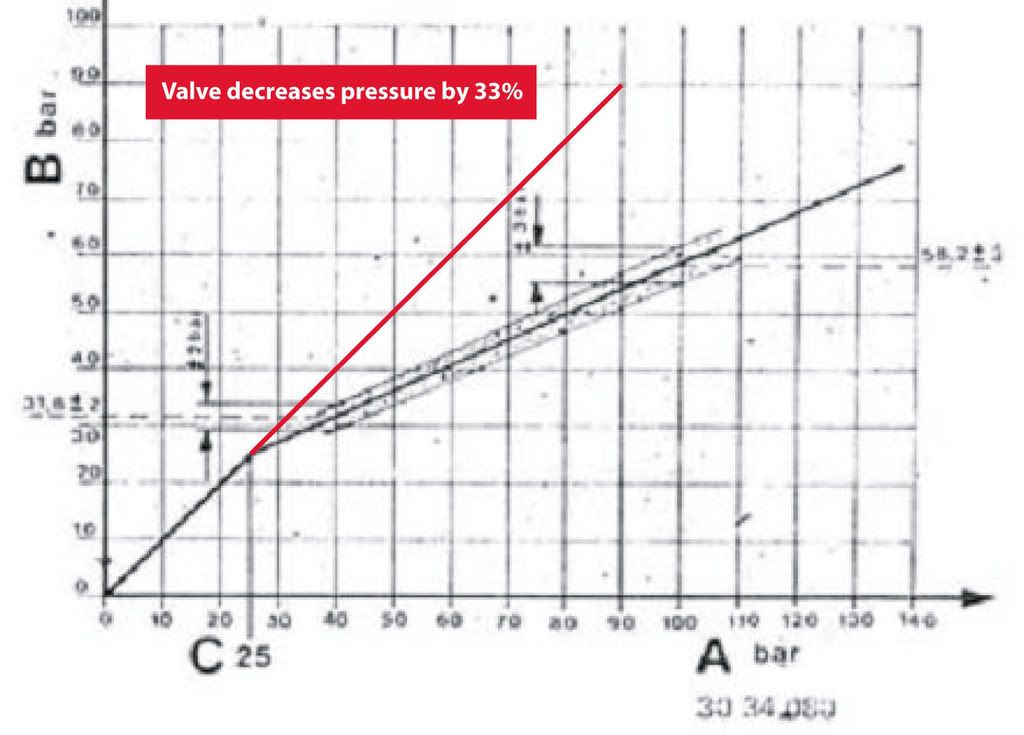
A "true" proportioning valve (or balance valve) doesn't introduce a knee point, rather pivots the line on the graph around 0,0 giving a % of front pressure to the rear axle regardless of pedal pressure. You can have adjustable valves which do this (effectively a bias valve with the knee point fixed at 0 bar, and an adjustable bleed) or you can have a twin mc pedal box with balance bar to achieve this. You can also have a fixed balance based on piston sizes, disc diameters, mc diameters, etc. and this is present on almost all cars
The valves perform different functions, so my point was make sure you fit the right one to achieve what you're trying to do or you can get in a right tangle with adjustments! You also may be leaving braking performance on the table at the top end, OR running too little rear bias at lower pedal applications which can make a car feel weird to drive on the road.
Not really relevant for a 914, but if you have a car with ABS its highly likely the bias is taken care of inside the pump/ecu and the knee point (and potentially the balance) is controlled automatically. adding a second valve downstream of the ABS pump (ie on the rear lines) gives some REALLY weird and inconsistent behaviour where the calipers are not experiencing what the ABS pump thinks they are Fitting things up-stream (ie twin mc / balance bar set-up) is usually OK
Re: gravity bleed - I've found this works really well on a dry system, especially where there are awkward components or runs of pipe where you can spend forever trying to get air out! The trick is to keep the movement of fluid through the system as slow as possible to ensure all air is eliminated.
I found modifying the lid of a (well cleaned) 2l coke bottle with a bulkhead/barb fitting, and then running a hose from this to a similarly modified reservoir cap (or using one from a pressure bleeder) works well - I can hang three of these in the roof of the garage (about 8ft off the ground) above the car (so around 3ft above the reservoirs with the car up on axle stands) with about 1-2 litres in each depending on circuit. then crack the bleed nipples and wait! I have 4 line brakes in all cars, so tend to open one rear and one front at a time rather than both - bleeding the furthest wheels first. If you have 3 line brakes (ie 1 line to the rear axle) then you'd need to do both together.. I found you can start with very small openings as you're mostly pushing air with a small amount of fluid, however you may have to open them slightly more as you go along as the system fills up.. Tip I got from a friend was to mark the fluid level on the bottles every couple of hours and check you're introducing fluid at a fairly consistent (and slow) rate. First time I did it, it took nearly 3 days to completely bleed the system, as the fluid slowed right down towards the end of the process. I've done it quicker since - starting around mid-morning on a Saturday and finishing up sometime around Sunday afternoon.
I've never had much luck using a pressure bleeder for anything other than a fluid change (ie full and bled system) however this gravity method works really well - its just painfully slow!
I've heard a proper vacuum bleeder works really well too as it evacuates the system before filling (similar to an A/C recharge) however I've always been warned off using them by our brake supplier at work - they don't recommend using vacuum on a braking circuit in case it inverts or rolls seals
HTH
Ben
PS. Sorry this is turning into an epic! If you've fitted new master cylinders, I'd recommend bench bleeding if you can, or at least following a typical bench bleeding process in the car (ie starting with very small cylinder movements, increasing stroke slightly each time and pushing out a small amount of air per stroke until the cylinders are completely full). This helps avoid dieseling of seals, but also helps get all the air of of the cylinders and from around the seals
picture below.. This shows a bias valve operation, to reduce brake pressure to the rear line(s) above a certain brake pressure. As you say the adjustment moves the "knee point" and is to tune the brake performance based on shifting of the cars weight during heavy braking, effectively reducing rear bias as weight moves off the rear axle. Not particularly relevant if you have mega-stiff springs, low weight, and low C.O.G, but as we're talking about a car with doors we're not in that category
A "true" proportioning valve (or balance valve) doesn't introduce a knee point, rather pivots the line on the graph around 0,0 giving a % of front pressure to the rear axle regardless of pedal pressure. You can have adjustable valves which do this (effectively a bias valve with the knee point fixed at 0 bar, and an adjustable bleed) or you can have a twin mc pedal box with balance bar to achieve this. You can also have a fixed balance based on piston sizes, disc diameters, mc diameters, etc. and this is present on almost all cars
The valves perform different functions, so my point was make sure you fit the right one to achieve what you're trying to do or you can get in a right tangle with adjustments! You also may be leaving braking performance on the table at the top end, OR running too little rear bias at lower pedal applications which can make a car feel weird to drive on the road.
Not really relevant for a 914, but if you have a car with ABS its highly likely the bias is taken care of inside the pump/ecu and the knee point (and potentially the balance) is controlled automatically. adding a second valve downstream of the ABS pump (ie on the rear lines) gives some REALLY weird and inconsistent behaviour where the calipers are not experiencing what the ABS pump thinks they are
Fitting things up-stream (ie twin mc / balance bar set-up) is usually OKRe: gravity bleed - I've found this works really well on a dry system, especially where there are awkward components or runs of pipe where you can spend forever trying to get air out! The trick is to keep the movement of fluid through the system as slow as possible to ensure all air is eliminated.
I found modifying the lid of a (well cleaned) 2l coke bottle with a bulkhead/barb fitting, and then running a hose from this to a similarly modified reservoir cap (or using one from a pressure bleeder) works well - I can hang three of these in the roof of the garage (about 8ft off the ground) above the car (so around 3ft above the reservoirs with the car up on axle stands) with about 1-2 litres in each depending on circuit. then crack the bleed nipples and wait! I have 4 line brakes in all cars, so tend to open one rear and one front at a time rather than both - bleeding the furthest wheels first. If you have 3 line brakes (ie 1 line to the rear axle) then you'd need to do both together.. I found you can start with very small openings as you're mostly pushing air with a small amount of fluid, however you may have to open them slightly more as you go along as the system fills up.. Tip I got from a friend was to mark the fluid level on the bottles every couple of hours and check you're introducing fluid at a fairly consistent (and slow) rate. First time I did it, it took nearly 3 days to completely bleed the system, as the fluid slowed right down towards the end of the process. I've done it quicker since - starting around mid-morning on a Saturday and finishing up sometime around Sunday afternoon.
I've never had much luck using a pressure bleeder for anything other than a fluid change (ie full and bled system) however this gravity method works really well - its just painfully slow!
I've heard a proper vacuum bleeder works really well too as it evacuates the system before filling (similar to an A/C recharge) however I've always been warned off using them by our brake supplier at work - they don't recommend using vacuum on a braking circuit in case it inverts or rolls seals
HTH
Ben
PS. Sorry this is turning into an epic! If you've fitted new master cylinders, I'd recommend bench bleeding if you can, or at least following a typical bench bleeding process in the car (ie starting with very small cylinder movements, increasing stroke slightly each time and pushing out a small amount of air per stroke until the cylinders are completely full). This helps avoid dieseling of seals, but also helps get all the air of of the cylinders and from around the seals
-
gridgway
- Nurse, I think I need some assistance
- Posts: 5724
- Joined: Tue Sep 02, 2008 10:59 pm
Re: 2 paces forward, 2 paces back
We are saying the same thing Ben, but I haven't even found a valve that doesn't have a knee! Only looked on the usual race websites though, AP, Tilton, Wilwood etc. One source I read from a US website says they are lke that.
Mind you at the moment, there's not a hope of locking any of the wheels!
Graham
Mind you at the moment, there's not a hope of locking any of the wheels!
Graham
-
smallspeed
- I used to have a life, then came DDK
- Posts: 3856
- Joined: Mon Mar 31, 2008 12:38 pm
- Location: leicester
- Contact:
Re: 2 paces forward, 2 paces back
I think most now are adjustable knee type as balance is sorted either through correct m/c sizing, with a balance bar, or through the abs pump
-
914 KEV
- DDK rules my life!
- Posts: 1168
- Joined: Fri Jul 31, 2009 2:40 pm
- Location: Surrey
Re: 2 paces forward, 2 paces back
Over the years I have quite a few different brake problems to fix on numerous 914s of my own and for other 914 owners.
There are other parts of the brake circuit which could be causing the problem and not just the brake equaliser especially as you are saying the braking is poor.
Are you hearing the brake equaliser clicking?
On a normal road use 914 where the brake calipers are standard there should be no reason to fit an aftermarket adjustable one.
For example I would also be looking at the brake master cylinder.
Also are the rear brake venting clearances set correctly; if not they will cause the brake pedal to travel a greater distance?
There are other parts of the brake circuit which could be causing the problem and not just the brake equaliser especially as you are saying the braking is poor.
Are you hearing the brake equaliser clicking?
On a normal road use 914 where the brake calipers are standard there should be no reason to fit an aftermarket adjustable one.
For example I would also be looking at the brake master cylinder.
Also are the rear brake venting clearances set correctly; if not they will cause the brake pedal to travel a greater distance?
914 Daily driver since 1990
-
gridgway
- Nurse, I think I need some assistance
- Posts: 5724
- Joined: Tue Sep 02, 2008 10:59 pm
Re: 2 paces forward, 2 paces back
Hi Kevin, I think this is definitely a job for you. I've done all the easy stuff, just need to make it all work now!
We could hear the equaliser clacking when we were bleeding. I started with a helper on the pedal, but finished with an easibleed.
Venting clearances are pretty tight. Master cylinder is a possibility, I'm always worried when they get used for bleeding.
I'll call you tomorrow. Are you around and free on Saturday by any chance?
Graham
We could hear the equaliser clacking when we were bleeding. I started with a helper on the pedal, but finished with an easibleed.
Venting clearances are pretty tight. Master cylinder is a possibility, I'm always worried when they get used for bleeding.
I'll call you tomorrow. Are you around and free on Saturday by any chance?
Graham
-
gridgway
- Nurse, I think I need some assistance
- Posts: 5724
- Joined: Tue Sep 02, 2008 10:59 pm
Re: 2 paces forward, 2 paces back
And how does the rear work with venting clearances? As soon as the rear pads wear, they will be out surely?
-
Barry
- Nurse, I think I need some assistance
- Posts: 4321
- Joined: Tue Aug 24, 2004 8:50 pm
- Location: East Sussex
Re: 2 paces forward, 2 paces back
One very simple thing to check (and I'm sure you have) is to get someone on the brake pedal whilst you go round each corner with a good light. Just make sure there's not a pad or two bending onto the disk rather than hitting flat.
When I did my first 911 all those years ago, I went through litre after litre of brake fluid, convinced it was a hydraulic issue of some sort. Eventually I realised two of the pads weren't hitting the disk absolutely square, and the spongy pedal was the result.
I know you've driven it a bit, but given you said the pedal was fine before, not so very much has changed since then. Whatever, it's a fast, easy and free check, and might be worth a thought?
In my case, once I found the above, I simply drove it for a careful few miles (it stopped fine) and the pedal came up and got firmer and firmer. In the end it was perfect.
When I did my first 911 all those years ago, I went through litre after litre of brake fluid, convinced it was a hydraulic issue of some sort. Eventually I realised two of the pads weren't hitting the disk absolutely square, and the spongy pedal was the result.
I know you've driven it a bit, but given you said the pedal was fine before, not so very much has changed since then. Whatever, it's a fast, easy and free check, and might be worth a thought?
In my case, once I found the above, I simply drove it for a careful few miles (it stopped fine) and the pedal came up and got firmer and firmer. In the end it was perfect.
DDK Member1243 07741 273865. Home of the RY Austin 7 Trophy's and Austin Single Seat Racers
-
gridgway
- Nurse, I think I need some assistance
- Posts: 5724
- Joined: Tue Sep 02, 2008 10:59 pm
Re: 2 paces forward, 2 paces back
Yes, good idea. All my willing assistants abandoned ship at the weekend, so I will get back to it on Sat. Kevin's coming round on Saturday afternoon and if that doesn't fix it, nothing will 